
B₄C boron carbide powder is superhard ceramic powder. It is produced by smelting in electric arc furnaces, purification, ultrafine grinding and classification. It serves as the core hard additive for the coating of iron-based and chromium-based hardfacing electrodes and flux-cored wires such as D916, D958 and BD-070. Under the high temperature of welding arc, part of the original hard particles remain in the deposited layer, and part precipitates high-hardness boride reinforcing phases including FeB and CrB in-situ. It greatly increases the hardness and abrasive wear resistance of the hardfacing layer. As a cost-effective alternative to tungsten carbide, it is widely used in welding consumable formulas for wear repair of mining, coking, cement, power plant and sand and gravel equipment.
Core Advantages (for welding consumable formula manufacturers)
Ultra-high hardness, remarkable wear improvement Mohs hardness 9.36, Vickers hardness approx. 4950HV, second only to diamond and cubic boron nitride. With proper addition, the hardness of hardfacing layer can be steadily maintained at HRC60–72. It resists sand and gravel erosion, dry grinding and mineral scraping, and its wear service life is much longer than ordinary high-chromium electrode systems.
In-situ boride formation to strengthen deposited microstructure Boron elements dissolve uniformly in the welding pool and disperse to precipitate acicular borocarbides, realizing grain refinement and solid solution strengthening. Combined with Cr, Mo, V and Ni alloy systems, it balances hardness and toughness and reduces cracking and spalling risks of the weld layer.
High purity and low impurities for stable welding performance Free carbon, iron and silicon impurities are strictly controlled. The powder features narrow particle size distribution and strict oversize particle control. When added into electrode coating, it ensures stable arc, low spatter and good slag detachability, and reduces pores and slag inclusions. The hardfacing performance remains consistent across batches.
High temperature resistance and excellent chemical stability Melting point approx. 2450℃. It does not soften easily under red-hot working conditions, suitable for hardfacing of high-temperature wear spare parts in coking plants and power plants. It resists acid and alkali corrosion and fits slurry and ore slurry erosion conditions.
Outstanding cost advantage Compared with cast tungsten carbide, it has lower raw material cost and stable supply. It is the preferred cost-reduction raw material for welding consumables under medium-low impact and heavy abrasive wear conditions.
Recommended Particle Size Selection (Special for Hardfacing Electrodes)
表格
| Formula Scenario | Recommended Grade | Description |
|---|---|---|
| Conventional D916, D958 hardfacing electrodes | F240 / F320 / F400 | Versatile, moderate reaction in welding pool, balanced wear resistance |
| Fine coating, thin hardfacing layer, flux-cored wires | F600 / F800 / F1200 | Good dispersibility, uniform reaction, fine weld microstructure, less spalling of large particles |
| Modified high-end electrodes, high wear-resistant formulas | Ultrafine classified / coated modified powder | Lower burning loss, uniform hard phase distribution, for premium wear-resistant welding consumables |
Custom particle sizes are available upon customer process requirements. COA for particle size and composition test can be provided. The powder boasts good flowability and will not agglomerate when mixed with graphite, ferrochrome, molybdenum iron and other alloy powders.
Basic Physical & Chemical Indexes
- Product Name: Boron Carbide Powder (B₄C)
- Crystal System: B₄C trigonal system
- B₄C Purity: ≥95% (high-end grade ≥97%)
- Free Carbon (F.C.): ≤0.8%, Fe₂O₃: ≤0.3%
- True Specific Gravity: 2.52 g/cm³
- Melting Point: ≈2450℃
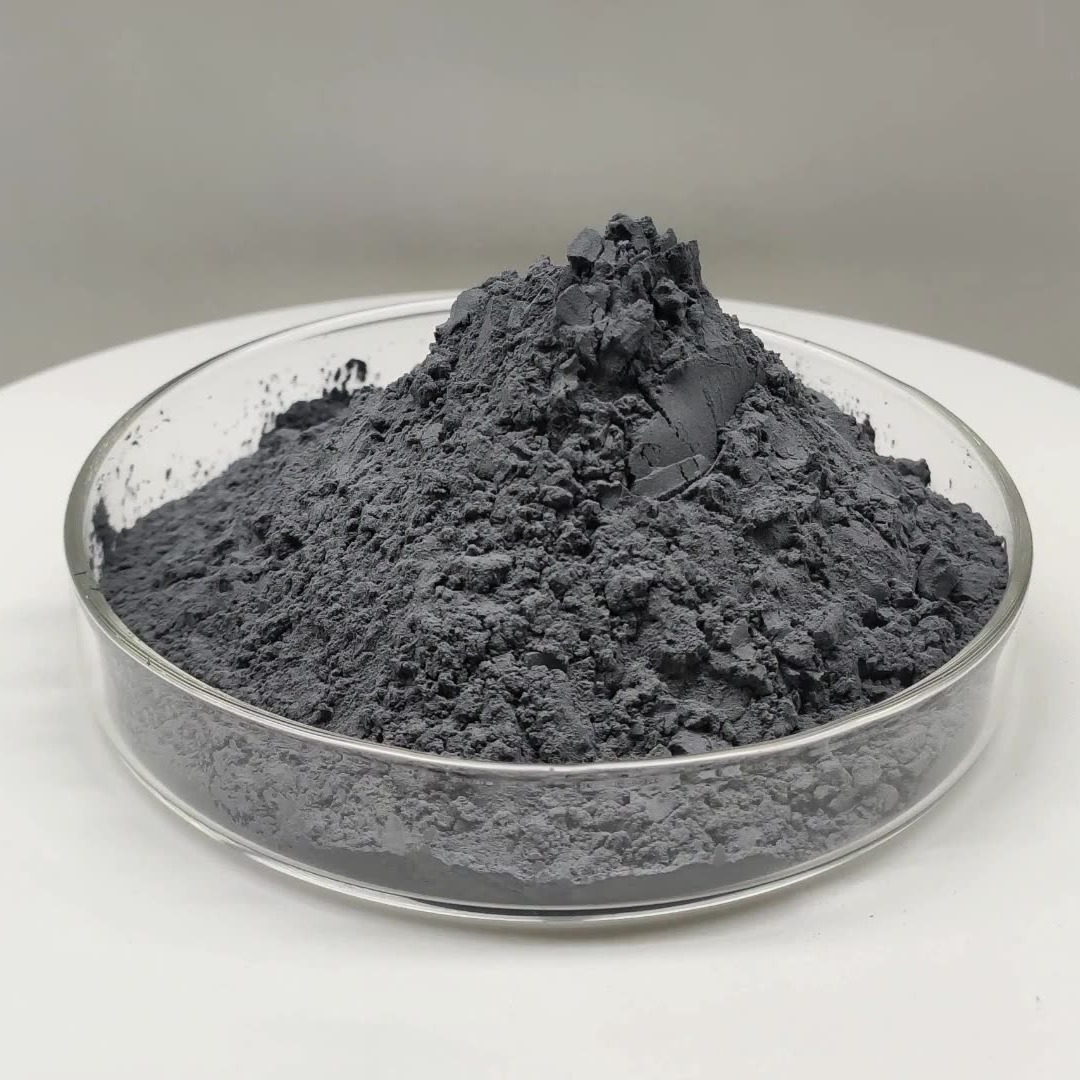
- Appearance: Grey-black ultrafine powder
- Compliance: MSDS available for export supporting documents
Application Scope
Additive for coating of D916, D958, EDZB1-Cr boron carbide hardfacing electrodes and flux-cored wires
Hardfacing repair welding consumables for mining chutes, crusher liners, coking charging guide rails, coal mill roller sleeves, fan impellers and slurry pump impellers
Formulas of wear-resistant electrodes for mixing blades, sieve plates and spiral blades in cement, brick and sand industries
Iron-based, chromium-based and nickel-based hardfacing systems, partial replacement of tungsten carbide raw materials