
Application of Boron Carbide in Hard‑Facing Welding Flux
Working Principle
As a boron‑element additive, boron carbide is incorporated into electrode coatings, powder cores of flux‑cored wires and hard‑facing fluxes. At high welding temperature, B₄C decomposes and boron enters the deposited metal, forming hard boride phases (FeB, CrB) of iron and chromium which disperse in the weld matrix.
The hardness of the hard‑facing overlay can reach HRC 60‑70, delivering excellent resistance to abrasive wear at a lower cost compared with tungsten carbide. boron carbide acts as a deoxidizer to purify the weld pool.Risk reminder: Boron increases hardening tendency. Excessive addition will cause cracking and high brittleness of the overlay.
Selected Specifications
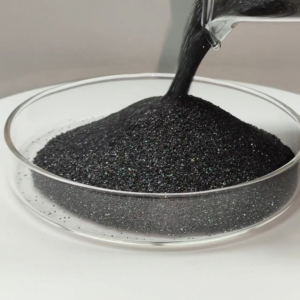
- Particle Size: 80‑200 mesh boron carbide powder is commonly used for hard‑facing flux.
‑ Over‑coarse particles may lead to slag inclusion and incomplete fusion.
‑ Excessively fine powder suffers severe oxidative burning loss during welding with low utilization rate.
- Purity: B₄C ≥94%‑97%, iron impurities shall be strictly controlled.
Application Forms
- Manual hard‑facing welding electrodes: Manufacturers mix boron carbide powder into alkaline low‑hydrogen electrode coatings, with D916‑series wear‑resistant electrodes as a typical representative.2.Flux‑cored hard‑facing wires: We blend boron carbide into the core powder for open‑arc automatic hard‑facing, which is suitable for mass repair of workpieces.
- Powder hard‑facing flux: Used as one component of alloy powder for plasma hard‑facing and oxy‑acetylene spray welding.
Service Conditions
Suitable for: Abrasive wear caused by sand, ore and slurry; working conditions with medium‑to‑low impact load.
Mining middle troughs, auger blades, crusher liners, mixer blades, brick‑making screws, fan impellers, mud pump wetted parts and chutes.